MRVPD invests energy and resources toward creating and maintaining a “safe, environmentally friendly, efficient, and integrated transportation network” in the Mad River Valley (MRV Vision Statement).
We work to support both active and mechanized transportation that unites the four corners of the Mad River Valley, while providing access to and from other vibrant Vermont destinations. A diversity of transportation options - from walking to public transit - is an important component of a healthy, safe, and connected community. Further, the transportation sector accounts for over 44% of greenhouse gas emissions in Vermont, contributing additional urgency and timeliness to the work.
In this section:
- MRV Transportation Advisory Committee
- Community Transportation Resources
- MRVPD Transportation Initiatives & Partnerships
Learn about the
As an arm of the Mad River Valley Planning District, the MRV TAC provides a forum for the public to share and recommend planning improvements to the transportation system. It expands local decision-making and planning of transportation priorities, projects, and long-range plans to address transportation issues in the Mad River Valley.
The MRV TAC meets monthly at the General Wait House, 4061 Main Street, Waitsfield. Please check the MRVPD Calendar to confirm meeting time and location, or contact office@mrvpd.org or 802-496-7179. For more information, visit the MRV TAC page.
The current pandemic has meant more folks walking, biking, driving, horseback riding - you name it! - on our rural roads. While this is fantastic in many ways, different types of travelers sharing the road can be challenging.
MRV TAC is working to gather local resources to help ensure everyone is safe on the road. Below are two guides to get started:
- Share the Road (VTrans) booklet, authored by MRV resident & MRV TAC member Kevin Russell
- Rules of the Road (Local Motion) brochure
Ridesharing is a great way to reduce driving alone (meaning less money out of pocket, less cars on the road, and less to worry about!), and MRV residents can find a number of resources through Go! Vermont.
Join Go! Vermont to find co-workers and neighbors to carpool and get rewarded!
MRV Park & Ride Locations:
- Fayston Town Offices
- East Warren Community Market
- Warren Town Offices
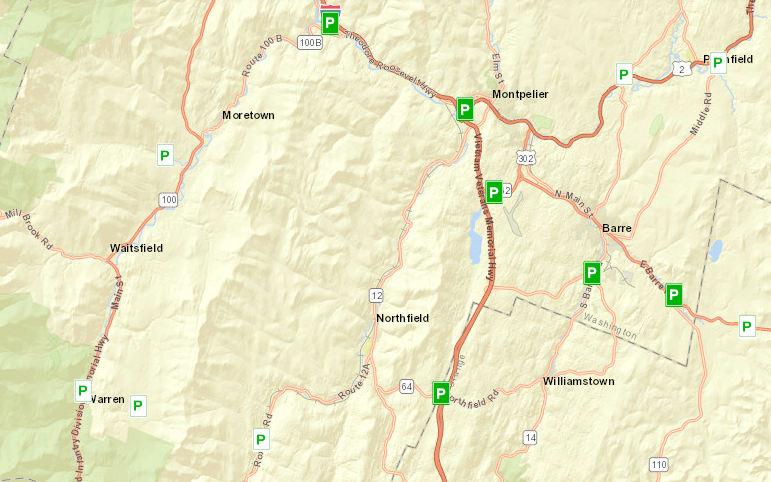
Park & Ride Locations
The MRV Bus will end on 3/28 for the 2020/2021 season.
Check the 2020-21 Bus Map and Schedule for more information here.
The MRV Bus (formerly "Mad Bus") is a winter-seasonal bus service operated by Green Mountain Transit (GMT). Daily service runs late December through early April. The MRV Bus consists of 5 routes:
- 120 Valley Floor
- 121 Valley Evening Service*
- 122 Mount Ellen
- 124 Mountain Condos
- 125 Access Road
*In addition to regular daytime routes, the Valley Evening Service runs on Saturdays, select Sundays, and New Years Eve; fare is required for the Valley Evening Service route and can be paid in cash or through the Token Transit App. The Valley Evening Service is suspended for the 2020-21 season due to COVID-19.
See the latest MRV Bus Service Ridership Report by GMT here.
Find a live system map here.

Mad River Valley towns are connected by a watershed-wide network of trails and paths stewarded by several active trail organizations, many of which can be used for transportation in addition to recreation. Visit Trail Finder to find more information about one of the many paths that can be used for commuting and getting around!
As you're walking or biking around, make sure to look out for one of the Valley's new Trailhead Kiosks!
Local Walk/Bike Resources:

Trailhead kiosk at Scrag Mountain Town Forest. (July 9, 2018). Source: Bob Cook & Joshua Schwartz
GMT Elderly & Disabled Service
Green Mountain Transit provides transportation services for individuals who are 60 years of age or older and/or individuals with disabilities, including transportation for non-Medicaid medical appointments, meal sites, senior centers, shopping and pharmacy trips, radiation and dialysis treatment and general daily needs. For more information, call 802-223-7287.
Free Wheelin'
The Mad River Valley Senior Center launched Free Wheelin' in 2019, a volunteer-driven program to provide free transportation for seniors and others with limited mobility. For more information, call 802-249-3427.
Electric Vehicles (EVs) are quickly becoming more accessible for folks looking to reduce their fossil fuel consumption and vehicle costs, thanks to newer technology and various incentive programs.
Visit Drive Electric Vermont for more information about buying, leasing, or test driving an EV.

MRV Electric Vehicle charging stations, as of 2/2020.
Community planning, advocacy and collaboration has led to several recent projects in the Mad River Valley that have increased village connectivity and safety. Waitsfield’s Village West Sidewalk project, due to be constructed summer 2021, will expand the village sidewalk, add two new crosswalks, and include bump outs for additional safety.
Following an October 2020 pedestrian tragedy in Waitsfield and increased usage of rural roads during the COVID-19 pandemic, pedestrian safety took on new urgency. In response to community feedback, Town of Waitsfield and MRVPD staff are working directly with the Vermont Dept. of Transportation (VTrans) to identify challenges and potential pedestrian safety improvements along Route 100.
For more information, see an update from the Town of Waitsfield here.
MRVPD worked with the Town, Local Motion, and VTrans to implement an in-street crosswalk signage pilot project at three locations for one month between June and July 2021. Presentation slides detailing the project results can be found here.
From "Wheels" to "Mad Bus"
In the early 1990s, the newly formed MRV TAC created a three-year pilot bus program with the goal of providing a Valley-wide and commuter bus system. In collaboration with MRVPD, Sugarbush and the MRV Chamber of Commerce, the MRV TAC crafted a Short Range Transit Plan that envisioned a cohesive, year-round Valley transit system.
The group sought grants with a funding structure comprised of 80% federal, 10% state, and 10% local match contributions. The MRV TAC was initially denied by the Vermont Legislature because the state felt that the money was primarily benefiting the ski areas. MRV TAC members testified before the VT Senate, ultimately leading to agreement that public transit was sorely needed and serviced the greater good rather than simply providing funds to the ski areas. With funding, the local group was able to procure buses, find a service provider, and begin providing fare-free transit known as “Wheels.”
Green Mountain Transit (GMT) assumed provision of transit in the MRV in 2003, converting the Wheels program to the “Mad Bus,” a fare-free seasonal shuttle service that covers the Valley Floor and Sugarbush Ski area. This service continues today under a new name, the Mad River Valley Bus Service.
See the latest MRV Bus Service Ridership Report by GMT here.
State routes in Middlesex, Moretown, Waitsfield, Warren and Granville were granted National Scenic Byway designation from the U.S. Secretary of Transportation in 2008.
The subsequent MRV Scenic Byway stretches 36.5 miles through Middlesex, Moretown, Waitsfield, Buels Gore, Fayston, Warren and Granville via Routes 2, 100, 100B and 17. The Mad River Byway is one of 10 scenic roadways in Vermont recognized for its archeological, cultural, historic, natural recreational or scenic qualities. Designation made the area eligible for federally funded projects, such as roadside kiosks, interpretive signage, mapping and promotional material. The work was led through a MRV Byway Committee with technical support from MRVPD and the Central VT Regional Planning Commission.
For more information visit the Mad River Valley Chamber of Commerce website.
MRV Moves
The Mad River Valley Moves Active Transportation Plan details a framework for a consistent, cohesive and connected regional system of trails, roads and sidewalks that provide a range of transportation options and recreational experiences for all user groups in the MRV, all while connecting users to the natural landscape and respecting the resources that make the Valley so special.
The Plan was led by MRVPD and funded in partnership by the Vermont Agency of Transportation Strong Communities, Better Connections Program; Vermont Agency of Commerce & Community Development; the towns of Fayston, Moretown, Warren & Waitsfield; the MRV Rotary Club; and the MRV Chamber of Commerce.
What is Active Transportation?
Planning for active transportation means providing for safe and convenient opportunities for physically active travel. This is particularly relevant in communities such as the MRV, where traditionally 'recreational' trails and paths are more frequently used for transportation.